Catering invoicing is the process of preparing and sending invoices for catering services that you provide outside your regular catering location. It differs from regular catering invoicing because you have to deal with more complex logistics, different VAT rates and specific administrative requirements for external events. Good catering administration ensures that you charge all costs correctly and comply with all tax regulations. In this article, you will learn everything about invoicing your catering services correctly, from mandatory information to useful tips for more efficient processes.
What exactly does catering invoicing entail?
Catering invoicing goes far beyond simply charging for food and drink. You are invoicing for a complete service that consists of several components. These include menu costs, staff, transport, materials such as crockery and tables, and often also the planning and coordination of the event.
The main difference between regular hospitality invoicing and catering invoicing is that catering involves external locations and predetermined prices. While guests in your restaurant order à la carte, catering usually involves quotations that you later convert into invoices. This means that you have to be much more precise in your calculations and administration.
For catering services, there are specific aspects that are important:
- Advance invoices for larger orders
- Separate invoicing of different cost items
- Correct VAT calculation per component
- Clear description of services provided
- Any additional costs such as parking fees or extra staff
What information should be included on a catering invoice?
A catering invoice must comply with all legal requirements, but often contains more details than a standard catering receipt. You have to deal with mandatory information that must be included on every invoice and specific information that is useful for catering assignments.
The mandatory information is:
- Your company details, including VAT number
- Customer details and billing address
- Unique invoice number
- Invoice date and delivery date
- Clear description of services provided
- Amounts excluding and including VAT
- VAT rate per component
- Total amount and payment terms
For catering services, you often add additional information such as:
- Event date and location
- Number of persons
- Specific menu items or packages
- Delivery time and duration of service
- Any special arrangements
| Invoice section | Mandatory | Catering specifically |
|---|---|---|
| Bedrijfsgegevens | Ja | Including event contact person |
| Services | Ja | Detailed per menu/service |
| Event venue | No | Useful for administration |
| Number of guests | No | Assists with control and service |
VAT rules for catering invoicing
VAT rules for catering can be quite complex because you often combine different services and products. It is important that you apply VAT to catering correctly to avoid problems with the tax authorities.
The following VAT rates usually apply to catering:
- Food and drink: 9% (low rate)
- Alcoholic beverages: 21% (high rate)
- Service staff: 21% (high rate)
- Equipment hire: 21% (high rate)
- Transport costs: 21% (high rate)
Please note that for combined services, each component must be calculated separately. For example, if you offer a total package including food, drinks and service, you must calculate internally which part falls under which VAT rate.
A useful tip is to always divide your invoices into clear categories. This not only makes it clearer for yourself, but also for your customer and any accountant.
Common mistakes in catering invoices
We know from experience that there are a few common mistakes that are easy to avoid. These mistakes can lead to problems with the tax authorities, dissatisfied customers or cash flow issues.
The most common errors are:
Incorrect VAT rates
Many entrepreneurs automatically charge 21% VAT on everything, while food and non-alcoholic beverages are subject to the low rate of 9%. This can cost your customers unnecessarily high prices.
Incomplete invoice details
Forgetting to include all mandatory information, such as a correct VAT number or unique invoice number. This may invalidate your invoice.
Unclear descriptions
Vague descriptions such as "catering services" cause problems during audits. Be specific about what you have delivered.
No advance invoices
For large orders, it is wise to request an advance payment. Many caterers forget this and run cash flow risks.
Incorrect invoice date
The invoice date determines the VAT period in which you must file your return. Ensure that this matches your records.
Tips for efficient catering invoicing
An efficient invoicing process saves you time and prevents errors. With the right approach, you can apply your invoicing tips immediately and see results right away.
Here are some practical tips you can implement today:
Work with standard templates
Create different invoice templates for different types of assignments. A wedding has different cost items than a business lunch, so adjust your template accordingly.
Invoice immediately after delivery
Send your invoice within 24 hours of the event. You will still have all the details fresh in your mind, and customers appreciate prompt service.
Use clear references
Always refer to your original quotation and use the same reference number. This makes it easier for everyone to check.
Split complex invoices
For large events, you may want to consider invoicing different components separately. For example, first the catering, then the additional services.
Automate where possible
Utilise software that automatically generates invoices from your quotations. This saves time and prevents typing errors.

Digital tools for catering invoicing
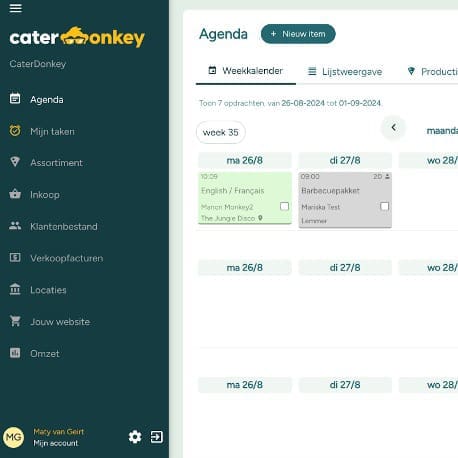
The right invoicing software can completely transform your invoicing process. Instead of manually typing invoices, you can generate professional invoices with just a few clicks that automatically contain all the correct information.
Modern catering software offers several advantages:
- Automatic conversion of quotations into invoices
- Correct VAT calculation per cost item
- Integration with accounting software
- Automatic reminders for outstanding invoices
- Overview of all financial data
Many catering companies still use Excel or Word for their invoices, but this often causes problems. It is easier to make mistakes, it takes more time, and you do not have automatic links to your other systems.
When selecting software for your catering accounting, consider the following functionalities:
- Simple link between quotations and invoices
- Option for advance invoicing
- Automatic VAT calculation
- Export to your accountant
- Reports on turnover and outstanding items
A good digital workflow ensures that everything from quotation to payment is handled in a single system. This provides you with greater clarity, saves time, and helps you appear more professional to your customers.
Catering invoicing doesn't have to be complicated if you take the right approach. By working systematically, applying VAT rules correctly and using digital tools, you can significantly improve your invoicing process. This gives you more time for what you're really good at: providing fantastic catering experiences for your customers. At Catermonkey, we help catering companies streamline their administrative processes every day so that they can focus on what they do best. Do you have questions about optimising your invoicing process? Contact us for personalised advice.
Ready to improve your invoicing process?
Do you have any ideas or questions about optimising your catering invoicing? Catermonkey is happy to help you figure out how our platform can support your business in streamlining all your administrative processes. From quotes to invoices, we help you free up more time to do what you do best.
Plan your brainstorming session with Catermonkey! Book your no-obligation brainstorming session here and discover how you can take your invoicing process to the next level.