You can create a professional catering quote by systematically including all the necessary elements: contact details, event details, menu options, prices, delivery conditions and payment terms. Focus on clear pricing, visually appealing presentation and good communication with your customer. A well-structured quote not only increases your conversion rate, but also strengthens your company image and customer confidence in the competitive catering market.

Why a good catering quote is so important for your business
Your quotation is often the first real contact a potential customer has with your company. It largely determines whether you will win the contract or whether a competitor will reap the rewards.
A professional quotation immediately builds trust. Customers can see from the way you present your quotation how carefully you are likely to organise their event. A messy, unclear quotation suggests that your working methods may also be messy.
In the competitive hospitality market, small details make all the difference. While your competitors may still be working with outdated Word documents, you can stand out with a well-thought-out, visually strong presentation. This often justifies higher pricing.
Furthermore, a well-structured quotation saves time in the follow-up process. When all information is clearly stated, you will receive fewer questions afterwards and customers will be able to make a decision more quickly.
What information should you always include in a catering quotation?
A comprehensive catering quotation contains various elements that together provide a clear picture of what you are offering. If you omit an element, this often leads to misunderstandings later on.
Contactgegevens en bedrijfsinformatie staan bovenaan. Zorg dat klanten je makkelijk kunnen bereiken en voeg je KvK-nummer toe voor extra betrouwbaarheid.
The event details form the core of your quotation:
- Date, time and location of the event
- Number of guests and any special requirements
- Type of occasion (company party, wedding, meeting)
- Specific requirements or dietary requirements
Describe your menu options as appetisingly as possible. Use tempting descriptions and clearly state what is included in each option. Think of appetisers, main courses, desserts and beverage packages.
Provide a clear overview of the prices per person or per item. Also state what is and is not included, such as crockery, staff, transport or set-up.
Clearly state your delivery terms and payment terms. When must the final confirmation be received? How do cancellations work? When do you expect payment?
How do you determine the right prices for your catering quote?
Pricing is a delicate balance between remaining competitive and maintaining sufficient margins. Always start with a thorough cost calculation before determining your selling price.
Calculate your ingredient costs per person. Use current purchase prices and take seasonal fluctuations into account. Don't forget to factor in a little extra for wastage and tasting.
Personnel costs often account for a large part of your total costs. Don't just calculate the hours during the event, but also include preparation time, transport and any dismantling. Think of chefs, waiting staff and possibly an event coordinator.
Transport and material costs vary depending on the location and type of event. Factor in mileage allowance, fuel costs and wear and tear on your materials. For external locations, there are often additional costs for transporting crockery and equipment.
You should spread your overheads across all your assignments. Think of rent, insurance, administrative costs, and marketing. A rule of thumb is to reserve approximately 15-25% of your direct costs for this.
For your profit margin, you can assume 20-35%, depending on your positioning in the market. Premium caterers can charge higher margins than budget providers.
What is the best way to make your quotation visually appealing?
A visually strong quotation stands out from the competition and exudes professionalism. Your corporate identity plays an important role in this.
Use high-quality photos of your dishes. People eat with their eyes, so appetising images can make all the difference. Ensure that the photos are well lit and show your dishes at their best.
A consistent layout with sufficient white space makes your quotation easy to read. Do not use too many different fonts and keep your colour palette limited to your brand identity.
Structure your information logically with clear headings and bullet points. Use tables for price overviews and ensure that important information stands out without being too flashy.
| Element | Tip | Why it is important |
|---|---|---|
| Logo placement | Top right or bottom left | Brand recognition |
| Use of colour | Maximum of 3 main colours | Professional appearance |
| Lettertype | Maximum of 2 different fonts | Readability |
| White space | At least 20% of the page | Clarity |
For returning customers, you can work with fixed formats that you can quickly adapt. This saves time and ensures consistency in your image.
How do you communicate effectively with customers during the quotation process?
Good communication starts with the first contact. Ask the right questions to understand exactly what your customer wants and expects.
Ask about the atmosphere and objective of the event. An informal team gathering requires a different approach than a fancy company dinner. The better you understand the wishes, the more targeted your quotation can be.
Respond quickly to requests for quotes. Customers often compare several providers, and whoever responds first often makes the best impression. Responding within 24 hours is now standard practice.
Be transparent about what is and is not possible within the budget. Offer alternatives if the wishes do not match the available amount. This shows that you are thinking along with the customer and are flexible.
Follow up on your quotation after a week if you have not heard anything. Do this in a friendly, non-pushy manner. Sometimes customers have overlooked your quotation or are still in the process of making a decision.
When dealing with change requests, remain patient and constructive. Adjust your quotation where necessary and clearly explain how changes will affect the price or schedule.
What common mistakes can you avoid when preparing quotations?
Many caterers make the same mistakes that reduce their chances of conversion. By recognising these, you can easily avoid them.
Unclear pricing is the biggest pitfall. Customers want to know exactly what they are paying for. Avoid vague terms such as "from" or "indicative" and give specific amounts for each item.
Late delivery of quotations regularly costs orders. Customers are often in a hurry to make their decision, especially for popular dates. Set up a system that allows you to respond quickly to requests.
Missing information leads to confusion. Always check that you have included all practical details: delivery time, necessary facilities on site, cancellation policy and contact details.
Quotes that are too general do not stand out. Tailor your proposal to your customer's specific situation. Refer to their company, the type of event and their specific wishes.
Spelling mistakes and typos undermine your professional image. Have someone else proofread your quotation before sending it, or use a spell checker.
Not stating clear next steps leaves customers in uncertainty. Indicate when you expect a response and what the follow-up process will look like after approval.
How do you ensure that your quotation stands out from the competition?
In a market full of suppliers, your quotation must stand out. You do this not only with the lowest price, but above all with added value.
Showcase your unique expertise by making specific suggestions that suit the event. Think of seasonal ingredients, themed menus or creative presentation styles that others do not offer.
Add personal service that others do not offer. These can be small extras such as a complimentary tasting, flexible delivery times, or personal guidance during the event.
Use stories and emotion in your descriptions. Instead of "salad with chicken," write "crispy salad with grilled chicken breast and homemade herbs from our own garden." This makes your offering much more appealing.
Offer different packages so customers can choose what suits their budget. A basic, standard and premium option gives customers a sense of control over their choice.
Demonstrate social proof by adding references or photos from similar events. This builds trust and shows that you have experience with this type of assignment.
Make it easy for customers to say yes. Offer online signing, provide clear payment options, and remove any objections by offering guarantees or flexible terms.
Creating professional quotes for hospitality and catering services takes time and attention, but it is an investment that pays off in more orders and higher prices. By working systematically and focusing on what customers really value, you can build a strong reputation in the market.
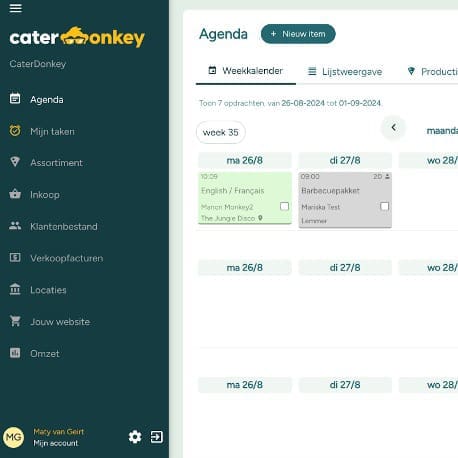
Want to further automate and professionalise this process? At Catermonkey, we've developed quotation solutions that make creating beautiful quotations a lot easier, giving you more time for what really matters: delivering fantastic catering.
Plan your brainstorming session with Catermonkey!
Do you have any ideas or questions about optimising your quotation process? Catermonkey would be happy to discuss how our platform can support your company in creating impressive quotations that really convert. Plan your brainstorming session with Catermonkey! - het is vrijblijvend en je kunt met alle vragen terecht.