The best pricing strategy for small catering businesses combines cost-conscious calculations with smart competition analysis and flexible adjustments per event type. You need to calculate your cost price accurately, apply a healthy profit margin of 20-35%, and use different pricing strategies depending on the type of event. Regular evaluation and adjustment of your prices will ensure long-term success.

What constitutes a good pricing strategy for catering companies?
An effective pricing strategy for catering companies balances three pillars: your actual costs, competitors' market prices, and the value your customers experience. This balance determines whether your business remains profitable and can grow.
Your pricing strategy begins with understanding your total cost structure. This includes not only ingredients, but also staff costs, transport, materials and overheads. In addition, you need to know what competitors charge for similar services.
The value you offer plays a major role in what customers are willing to pay. Consider your service level, presentation, flexibility, and reliability. These factors often justify higher prices than the cheapest competitor.
A good pricing strategy is also flexible. Weddings, business lunches and private parties require different approaches. You need to be able to switch between package prices and à la carte options, depending on what works best for each type of event.
How do you calculate the correct cost price for your catering services?
Cost calculation forms the basis of your pricing strategy. Start by accurately tracking all direct costs per dish or menu. This means not only the ingredients, but also the actual quantities you use.
Calculate your personnel costs per hour, including social security contributions. Add to this the time needed for preparation, service and tidying up. Many caterers forget to include travel time and set-up time in their calculations.
Calculate your personnel costs per hour, including social security contributions. Add to this the time needed for preparation, service and tidying up. Many caterers forget to include travel time and set-up time in their calculations.
Do not forget the hidden costs: transport, fuel, material loss, and time spent on quotations that do not lead to orders. These costs can amount to 15-20% of your total costs.
| Cost item | Percentage of total | Examples |
|---|---|---|
| Ingredients | 30-40% | Food, drink, herbs |
| Staff | 25-35% | Wages, social security contributions |
| Overhead | 15-20% | Rent, insurance, marketing |
| Transport & equipment | 10-15% | Fuel, crockery, losses |
What profit margin is realistic for small catering companies?
For small catering companies, a profit margin of 20-35% is realistic, depending on your specialisation and market position. Luxury catering can achieve higher margins, while volume catering often operates with lower margins.
Start with a minimum margin of 20% to keep your business healthy. This margin covers unexpected costs and allows room for investment in your business. Experienced caterers with a strong reputation can often achieve 30-35%.
Be mindful of seasonal influences. During busy periods such as the wedding season, you can apply higher margins. In quieter months, you may need to accept lower margins in order to secure assignments.
Different event types justify different margins. Weddings and exclusive events can command higher margins than standard business lunches. Adjust your margin based on the complexity and added value of your service.
How do you conduct competitive analysis for your catering prices?
Effective competitive analysis begins with identifying your direct competitors. Look for caterers who offer similar services in your geographical area and serve the same customer group.
Request catering quotes from competitors for different types of events. Do this in a fair manner, for example through friends or family. Analyse not only the prices, but also what is included in the quote and how it is presented.
Visit competitors at trade fairs and events. Observe their presentation, service level and customer interaction. This will give you insight into their value proposition and how they justify their prices.
Use online platforms and reviews to learn more about competitors. Customer feedback tells you a lot about what customers value and what they are willing to pay extra for.
Avoid a price war by focusing on your unique value. If you find that you are consistently more expensive, investigate whether you offer additional value that justifies this, or adjust your cost structure.

When and how do you adjust your prices?
Price adjustments are best made at the beginning of a new season or calendar year. This gives customers time to adjust and prevents surprises during busy periods.
Monitor your cost price developments regularly. Rising ingredient prices, higher wages or fuel costs are valid reasons for price adjustments. Do not wait too long to make adjustments, because catching up afterwards is more difficult.
Communicate price changes transparently to existing customers. Send a friendly letter or email at least 30 days in advance explaining the changes. Explain which cost increases make the adjustment necessary.
Communicate price changes transparently to existing customers. Send a friendly letter or email at least 30 days in advance explaining the changes. Explain which cost increases make the adjustment necessary.
Consider gradual adjustments rather than big leaps. A price increase of 5-8% per year is usually easier to sell than a one-off increase of 20%.
Which pricing strategies work best for different types of events?
Which pricing strategies work best for different types of events?
For corporate events and business clients, you often work with à la carte pricing. These clients want flexibility and are happy to pay for customised services. Offer different service levels, from basic to premium.
Bij terugkerende klanten zoals kantines of zorgcentra kun je volumekortingen of contractprijzen hanteren. Deze langetermijnrelaties rechtvaardigen lagere marges door de zekerheid van regelmatige opdrachten.
For repeat customers such as canteens or care centres, you can offer volume discounts or contract prices. These long-term relationships justify lower margins due to the certainty of regular orders.
Private parties and smaller events are suitable for a combination of basic packages with à la carte extras. For example, offer a standard drinks package with options to upgrade to more luxurious snacks.
Key points for a successful pricing strategy
A successful pricing strategy for your catering business requires accurate cost calculations, realistic profit margins and flexibility per event type. Monitor your costs and competition regularly, and adjust your prices in a timely manner.
Invest in professional quotations that effectively convey your value. A well-presented quotation justifies higher prices and increases your chances of success with potential customers.
Build strong customer relationships by being transparent about your prices and the value you deliver. Satisfied customers are willing to pay more for reliable service. For personal advice, please feel free to contact us.
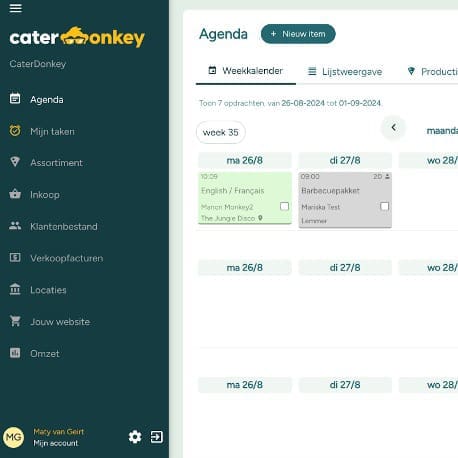
At Catermonkey, we understand that pricing strategy can be complex. Our software helps you accurately calculate cost prices, create professional catering quotes, and track your profitability per order. This gives you constant insight into your figures and allows you to make well-informed pricing decisions.
Plan your brainstorming session with Catermonkey!
Do you have questions about pricing strategy or want to know how our platform can support your catering business? Feel free to come to us with all your ideas and questions! Catermonkey is happy to work with you to see how our tools can help you with cost calculation, quotation management and profitability. Plan your brainstorming session with Catermonkey!
Boek hier je vrijblijvende brainstormsessie en ontdek samen met ons de mogelijkheden voor jouw bedrijf.